Cowboy Doodle: Hand-Drawn Western Icons for Authentic Design
There’s a particular warmth to hand-drawn illustration that polished vector graphics often miss. It’s the slight wobble in a line, the uneven texture of a hand-pressed stroke, the feeling that a real person sat at a desk and sketched it. This is the core appeal of Cowboy Doodle, a dingbats font that isn’t a traditional typeface at all, but a curated collection of western-themed icons. It’s designed to bring the character of a personal sketchbook—filled with frontier symbols—directly into your digital and print projects.
The Sketchbook Aesthetic in a Digital Font
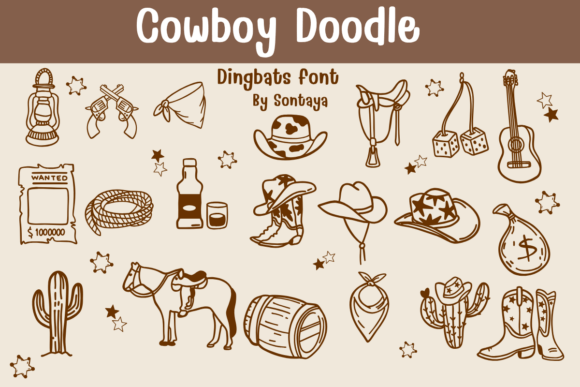
Cowboy Doodle delivers its charm through a consistent visual language. Each icon, whether it's a classic cowboy hat, a pair of worn boots, a coiled lasso, or a prickly cactus, is rendered with a monolinear stroke. This means the line weight is uniform throughout, giving the collection a cohesive, hand-lettered feel. The texture is intentionally organic and slightly sketchy, mimicking the look of pencil or pen on paper. This isn't a set of sterile, perfect symbols; it's a collection that feels authentic, rustic, and full of personality.
The icons themselves are a well-chosen roster of western motifs. You’ll find the expected—sheriff's stars, "Wanted" poster frames, horseshoes, and wagon wheels—alongside subtler symbols like campfire flames and desert wildlife. This specificity makes it an exceptionally practical design asset for anyone needing to evoke a clear, thematic atmosphere without hunting for generic clip art.
Where This Creative Font Truly Shines
Understanding a font's strengths is key to using it effectively. Cowboy Doodle isn't for body text or complex data visualization. Its role is as a display font for accent and illustration. Think of it as a set of stamps or stencils that inject personality into a layout. Its value is most evident in projects where brand identity and emotional connection are paramount.
- Themed Event Invitations & Stationery: For a barn wedding, a ranch-themed birthday party, or a country music event, Cowboy Doodle icons can be used as decorative borders, bullet points, or standalone illustrations on invitations, menus, and place cards. The handwritten font style adds a personal, crafted touch that feels more intimate than standard graphics.
- Rustic Boutique & Product Branding: Small businesses selling artisanal goods, leatherwork, or outdoor apparel can use these icons in logo design, packaging hang tags, and labels. A single well-placed boot or horseshoe icon can reinforce a brand identity rooted in heritage and craftsmanship, complementing a serif font for the business name or a sans serif font for supporting text.
- Editorial Design & Publishing: In a magazine layout, blog post, or cookbook focusing on southwestern cuisine or outdoor adventure, these icons serve as perfect spot illustrations. They can break up text, create visual interest in margins, or decorate chapter headings, enhancing the reader's experience without overwhelming the editorial design.
- Digital Presence & Social Media Graphics: For social media managers and content creators, Cowboy Doodle offers a quick way to create cohesive, themed content. Use the icons as profile picture frames, post dividers, or highlight covers on Instagram. They can unify a feed's aesthetic for a specific campaign or season, making social media graphics feel more curated and adventurous.
Practical Guidance for Implementation
Choosing to use a premium font like Cowboy Doodle involves more than just liking the icons. Here’s how to evaluate and implement it effectively:
First, assess your project's core needs. If your design requires clear, legible text for long-form reading, this isn't the tool. But if you need to set a thematic tone or add decorative elements, it’s ideal. Test a few icons at the actual size you'll use them. Do they maintain their clarity and character when small, like a bullet point? Do they hold up when large, as a central graphic?
Second, consider your font pairings. The rustic, hand-drawn style of Cowboy Doodle pairs best with clean, neutral typefaces. A classic serif font like Garamond or a simple, modern sans serif font like Helvetica Neue provides a strong, readable foundation that lets the icons stand out as special elements. Avoid pairing it with other overly decorative or script fonts, as this can create visual clutter and undermine professionalism.
Third, review the full character map. A quality dingbats font will include a range of icons. Explore the entire set to see all available symbols. You might discover perfect secondary icons—like a campfire or a desert plant—that add depth to your project beyond the obvious headliners. Also, confirm the commercial font licensing aligns with your intended use, whether for personal projects, client work, or merchandise.
Finally, mind the spacing and hierarchy. Icons from a font file will have built-in sidebearings. You may need to adjust tracking or use design software to place them precisely in relation to your text. Use them intentionally to guide the viewer's eye, not just as random decoration. A "Wanted" poster frame can become a clever container for a call-to-action, and a row of cacti can elegantly underline a section header.
In a digital landscape saturated with slick, generic graphics, Cowboy Doodle offers a return to tactile, story-rich illustration. It’s a creative font that provides more than symbols; it provides a sense of place, history, and handcrafted quality. By understanding its personality and applying it with strategic intent, designers, marketers, and creators can saddle up and bring a genuine slice of the Wild West to their visual storytelling.