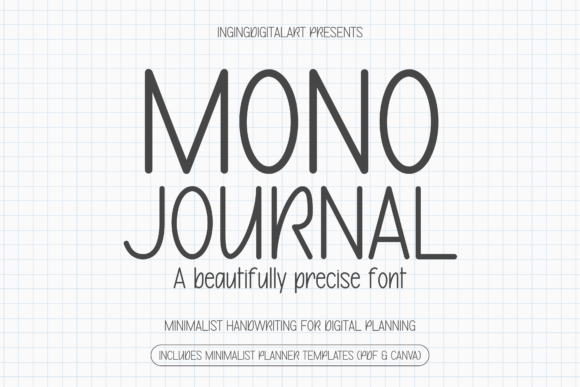
Mono Journal: Bringing Architectural Precision to Your Handwriting
Finding a font that feels personal yet impeccably structured can be a challenge. Many handwritten fonts sacrifice legibility for character, while rigid sans serif fonts can feel sterile in creative contexts. Mono Journal occupies a unique space. It’s a premium font designed with the discipline of an architect, delivering the organic warmth of a handwritten font through perfectly controlled, monoline strokes. This isn't about chaotic flourishes; it's about intentional, clear communication that respects both form and function.
Understanding the Mono Journal Aesthetic
At its core, Mono Journal is defined by its precision. The typeface features a consistent, single-weight line (monoline) that gives it a clean, technical feel. The high x-height—the height of lowercase letters like 'x' or 'a'—ensures that text remains highly legible, even when used at smaller sizes or in dense layouts. The joints where strokes meet are seamlessly closed, eliminating the visual noise that can make some script fonts difficult to read in body text. This creates a modern typography solution that feels both natural and purposeful, making it an excellent design asset for projects requiring clarity.
Key Visual Characteristics
- Monoline Strokes: Every line has uniform thickness, contributing to a balanced and orderly appearance.
- Controlled Letterforms: The shapes are simplified and geometric, avoiding excessive loops or swashes.
- Seamless Joints: Connections between letters are smooth and intentional, enhancing flow.
- Optimized for Grids: Its structure works beautifully in gridded layouts, from bullet journals to responsive web design.
Where Mono Journal Truly Shines
The strength of Mono Journal lies in its versatility across different mediums. It’s not a display font that shouts for attention; instead, it provides a consistent, professional voice that supports your content.
Digital Planning & Productivity
For users of apps like GoodNotes or Notability, Mono Journal is transformative. Its clean lines make digital handwriting neat and scannable. Use it to create structured notes, to-do lists, or monthly planners where clarity is paramount. The font’s legibility in tight grids means you can fit more information on a page without sacrificing readability, making your digital workspace feel organized and efficient.
Creative & Branding Projects
In brand identity, Mono Journal can be a strategic choice. It communicates approachability without sacrificing professionalism. Consider it for:
- Logo Design: Especially for brands in the productivity, stationery, or minimalist lifestyle sectors.
- Packaging Design: On product labels or inserts where a personal, handwritten note is desired but must remain legible.
- Social Media Graphics: For quotes, instructions, or carousel posts where text needs to be read quickly on small screens.
Editorial & Web Design
While not a primary body text font for long-form articles, Mono Journal excels in editorial design for pull quotes, annotations, or section headers. In web design, it can be used for short calls-to-action, button labels, or interactive elements where a touch of personality enhances user experience without compromising the site's overall clean aesthetic.
Making Mono Journal Work for You: Practical Guidance
Choosing a font is a practical decision. Here’s how to evaluate if Mono Journal is the right creative font for your next project.
Evaluating Project Fit
Ask yourself: Does the project benefit from a human, handwritten touch? Is the primary goal clear communication over artistic expression? Mono Journal is ideal for projects that value readability and a sense of personal craft. It’s less suited for grunge, vintage, or highly decorative designs where a more expressive script font would be appropriate.
Testing Font Pairings
A great font pairing creates visual interest and hierarchy. Mono Journal works well with:
- A Geometric Sans Serif: Like Montserrat or Poppins, for a modern, clean contrast.
- A Traditional Serif: Like Lora or Merriweather, to balance its contemporary feel with classic elegance.
- A Complementary Monoline Font: Use a different weight or style from the same family for subtle variation.
Considering Practicalities
Review the font package. Does it include the necessary glyphs and language support for your audience? Check the commercial licensing terms if you plan to use it for client work, products for sale, or large-scale distribution. Understanding these details upfront prevents legal issues later.
Ultimately, Mono Journal is more than just a handwritten font. It’s a tool for bringing deliberate, elegant structure to any project that calls for a human voice with a designer’s precision. By focusing on its strengths in clarity and versatility, you can make it a valuable part of your typographic toolkit.