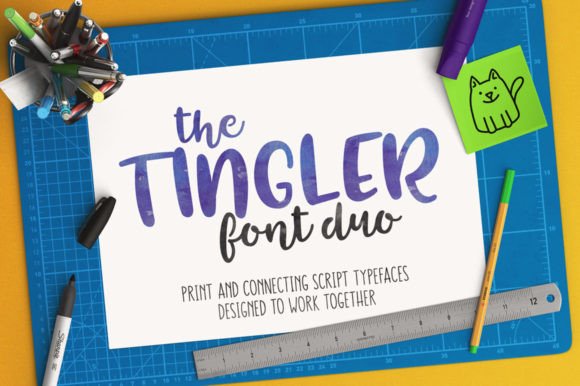
Tingler Duo: Crafting Authentic Handwritten Designs
When you’re building a brand or designing a project, the typography you choose does more than just convey words; it conveys personality. In the realm of modern typography, finding a font that feels genuinely human without sacrificing functionality is a significant win. This is where the Tingler Duo enters the conversation. It’s not just a single typeface, but a carefully engineered system comprising Tingler Script and Tingler Print. These two fonts were designed side-by-side to ensure they complement one another perfectly, offering a cohesive visual language that feels organic and hand-drawn.
The appeal of this package lies in its versatility. Tingler Script offers the fluidity of a connecting handwritten script, mimicking the natural flow of a pen on paper. It captures the spontaneity often required in brand identity work that targets a younger, more creative demographic. On the other hand, Tingler Print provides a printed handwritten aesthetic. The magic happens in the engineering: all lowercase letters in Tingler Print are specifically situated to accept the connecting tails from Tingler Script. This allows for a seamless transition between the two styles within a single layout, creating a dynamic visual hierarchy that keeps the reader’s eye engaged.
The Stencil Advantage: Engineering for Crafters and Makers
One of the most distinct technical features of the Tingler Duo is its construction regarding counters—the enclosed or partially enclosed spaces within letters like 'o', 'a', 'e', and 'b'. Traditional fonts usually have closed counters. However, the Tingler fonts feature no closed counters. This is a deliberate design choice that opens up a world of possibilities, particularly for those working with electronic cutting machines like Cricut or Silhouette.
If you have ever tried to cut intricate text out of vinyl or cardstock using a standard script font, you know the frustration of the centers of letters falling out or the machine struggling to weed the negative space. Because the Tingler fonts are essentially "stencil-ready" out of the box, they bridge the gap between digital design and physical production. This makes them an invaluable asset for packaging design, custom signage, and scrapbooking. You can move from a digital mockup to a physical product without needing to manually alter the letterforms to make them cuttable.
Real-World Applications: From Digital Screens to Physical Goods
Understanding where a premium font fits into your workflow is crucial for return on investment. The Tingler Duo is a display font at heart, meaning it shines brightest in headlines, logos, and attention-grabbing callouts rather than long-form body copy. Its personality is energetic and approachable, making it a strong candidate for specific industries.
Consider logo design for boutique businesses. A coffee shop, a handmade jewelry line, or a local bakery often wants to convey warmth and authenticity. Using a stiff, geometric sans serif font might feel too corporate. Instead, using Tingler Script for the main wordmark and Tingler Print for the tagline creates a unified look that feels bespoke. The lack of closed counters gives the logo a slightly rugged, artisanal edge that works well for brands wanting to appear "hand-crafted."
Beyond logos, this creative font is excellent for social media graphics. In a fast-scrolling environment, you need typography that arrests attention immediately. The staggered double-letter ligatures included in the package are particularly useful here. They prevent the repetitive look that often plagues handwritten fonts, giving words like "Happy" or "Summer" a natural, hand-drawn variation that looks organic rather than digital.
Strategic Font Pairing and Hierarchy
No font is an island, and even a versatile typeface like Tingler needs the right partners. When working on editorial design or web design, pairing is about contrast and readability. Because Tingler Script and Tingler Print are high-energy display fonts, they pair best with clean, neutral backgrounds and body text.
A classic strategy is to pair the Tingler Duo with a geometric sans serif font or a traditional serif font for body copy. For example, if you are designing a menu, you might use Tingler Script for section headers like "Appetizers" or "Desserts," and Tingler Print for specific dish names that need emphasis. The body description of the dish, however, should be set in a highly legible serif or sans-serif typeface to ensure customers can read the ingredients comfortably.
This combination leverages the strengths of both styles: the handwritten font provides character and visual hierarchy, while the standard typeface ensures legibility and professionalism. This balance is key in marketing materials where you want to capture a vibe but still need to convey critical information clearly.
Technical Specs and Global Reach
For the professional designer, technical specifications are just as important as aesthetics. The Tingler Duo package is robust, including almost 700 glyphs split between the two fonts. It is provided in both OTF and TTF formats, ensuring compatibility across different operating systems and design software.
Furthermore, the font supports a massive range of languages—over 200 accented characters in each font. This covers everything from English and French to Polish, Turkish, and Esperanto. If you are working on a project with an international audience or a client in Europe, you won't have to worry about missing diacritics. The fonts are also PUA-encoded, which means you can easily access all special characters and swashes through the Character Map on Windows or the Font Book on Mac, even if your software doesn't support OpenType features natively.
Evaluating the Fit for Your Brand
Before integrating any new design assets, it is wise to evaluate the fit. Ask yourself: Does my brand voice lean towards the informal and friendly, or is it strictly corporate? If your brand strategy involves human connection, storytelling, and a DIY spirit, the Tingler Duo is a strong contender.
However, readability considerations must be addressed. Because it is a handwritten font, it should generally be avoided for legal disclaimers, technical specifications, or small text on mobile screens. Use it where it has room to breathe—large headers, t-shirt designs, mugs, and posters.
Ultimately, the value of a commercial font lies in its ability to solve problems. The Tingler Duo solves the problem of needing a cohesive, hand-drawn aesthetic that is also technically viable for physical production (stencils/vinyl). It solves the problem of visual monotony with its staggered ligatures. By incorporating it thoughtfully into your workflow, you can elevate your projects from standard digital layouts to authentic, tactile experiences that resonate with your audience.